We build the AI factories
that live in space.
From the first commercial lunar data server to petabyte-class orbital data center nodes on the ISS, SpaceBilt designs and integrates the servers, storage, and infrastructure that turn stations into Orbital AI Factories – and all of it runs on our Orbital Data Stack.
INTRODUCING THE
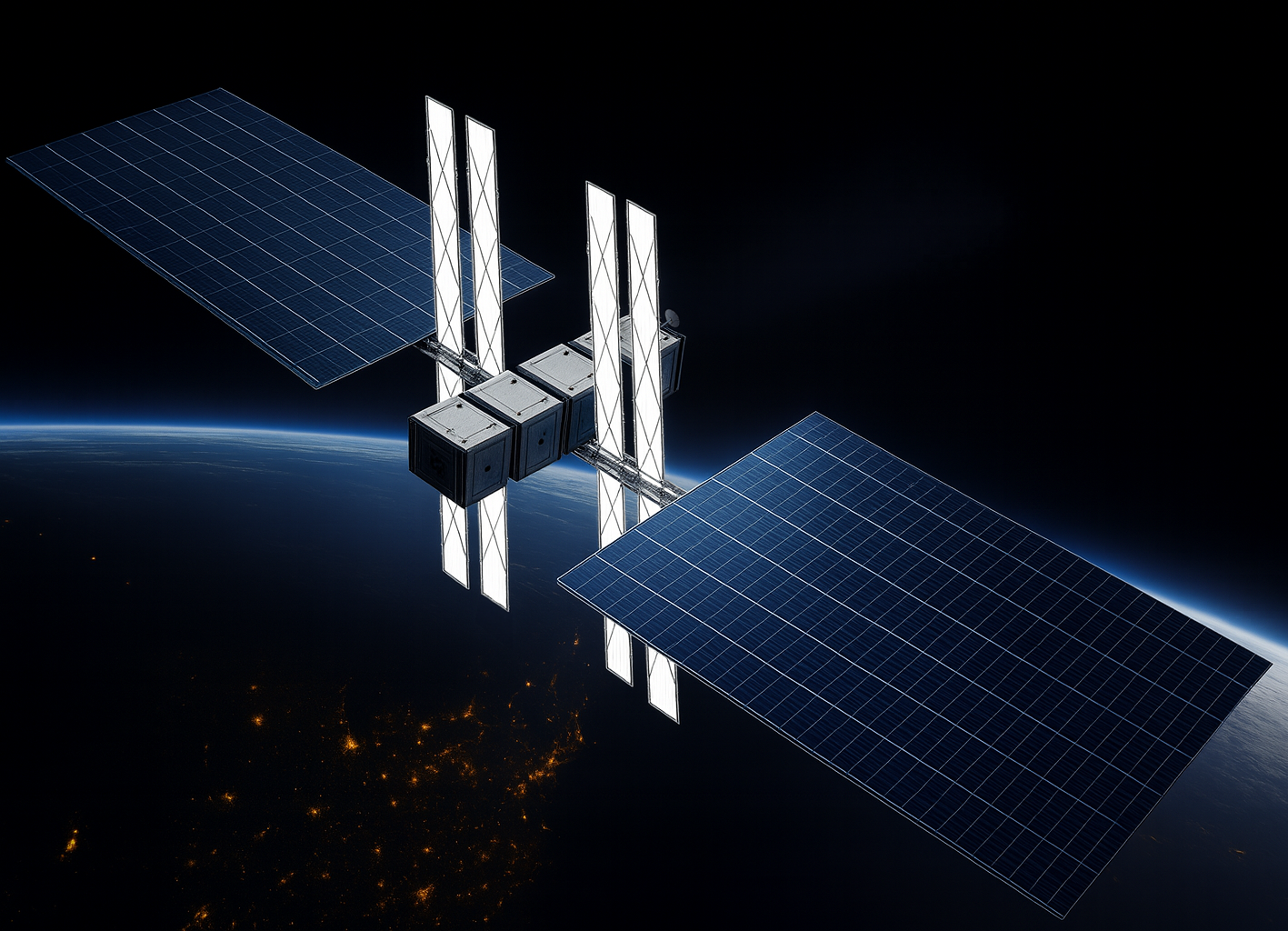
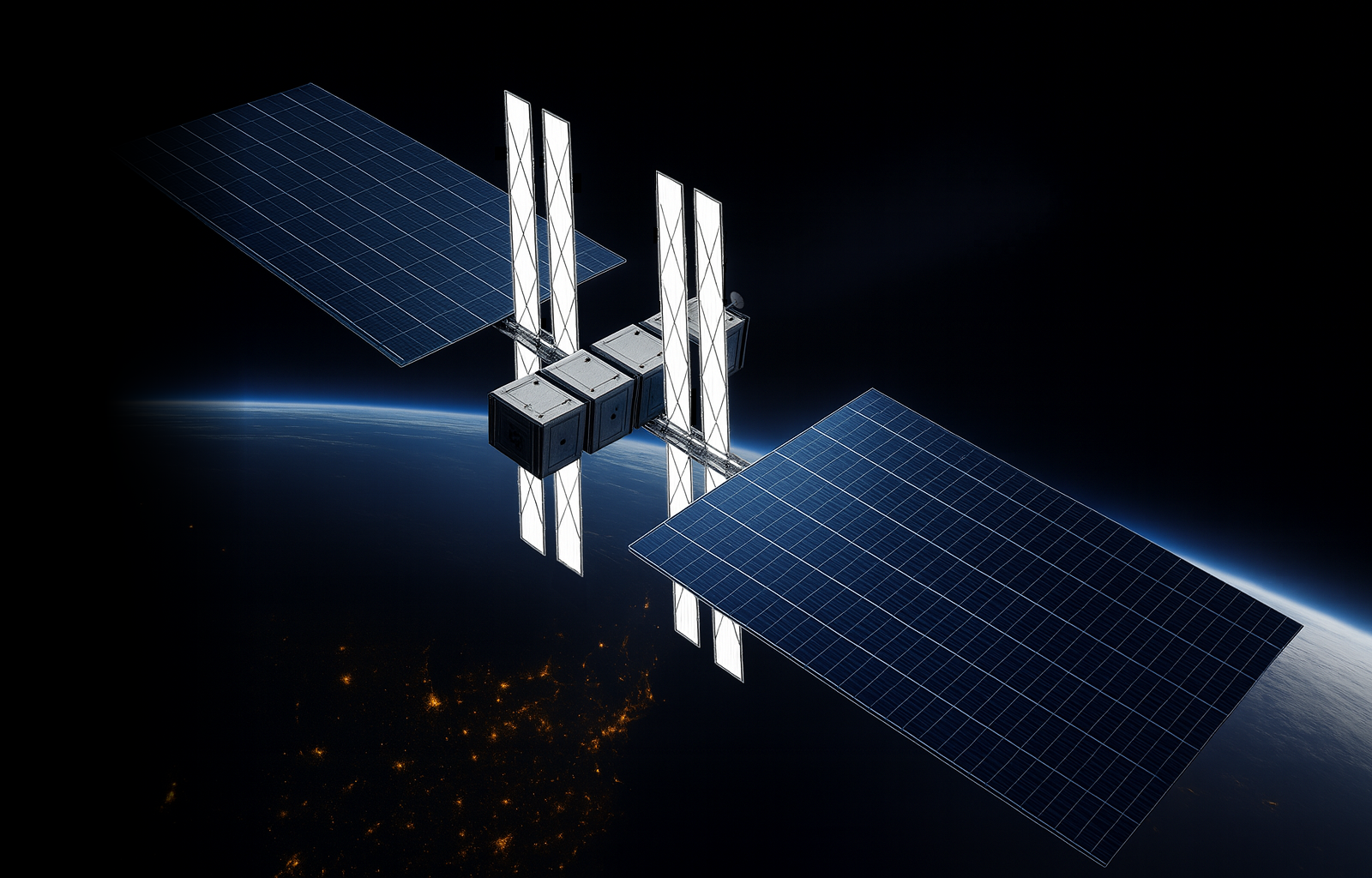
Orbital AI Factory
An Orbital AI Factory is a cluster of nodes in orbit that turns raw data into decisions: AI running next to telescopes, sensor constellations, stations, and in-space factories. Under the hood, every Orbital AI Factory runs on our Orbital Data Stack — the infrastructure that makes a data center work in space.
SpaceBilt isn't just talking about it. We've already flown the core layers of that stack:
Compute + storage layer.
Large in-Space Server (LiSS), the world's first 100+ TB orbital data server, flight-qualified on the ISS.
Data center node layer.
Axiom Orbital Data Center Node on the ISS, where SpaceBilt leads engineering and integration of optically interconnected, petabyte-class infrastructure.
Lunar and cislunar layer.
The first commercial data server to the Moon, generating real performance data in deep-space environments.
What is the Orbital Data Stack?
Three-layer breakdown:
1. Orbital Compute & Storage
Ruggedized servers and SSD arrays designed for radiation, vacuum, and thermal extremes — from 100+ TB LiSS units to petabyte-class AxODC nodes on the ISS.
2. Data Center Integration
Power, cooling, networking, and optical links that turn individual servers into a true orbital data center — including AxODC Node ISS with high-speed optical backhaul.
3. Orbital Logistics & Lifecycle
Design, qualification, launch integration, on-orbit operations, upgrades, and repurposing — so capacity can be added, moved, and modernized without de-orbiting hardware.
SpaceBilt is the only company with flight-proven hardware and partnerships across every layer of the Orbital Data Stack. Multiple Orbital Data Stack nodes on a station come together to form an Orbital AI Factory.
Why the Orbital Data Stack is hard.
Four things most companies can't do — and SpaceBilt already has:
1. Petabyte-class hardware in brutal environments
We've flown 100+ TB Large in-Space Servers on the ISS exterior and delivered the first commercial data server to the Moon, proving enterprise-class compute and storage can survive radiation, vacuum, and extreme thermal swings.
2. Real data center nodes, not one-off payloads
We're leading the engineering and payload implementation of Axiom's Orbital Data Center Node ISS — a petabyte-scale, optically connected infrastructure node that satellites, spacecraft, and stations can use as shared compute and storage, not just a single experiment.
3. Making COTS AI chips work in high-radiation environments
We're not building custom rad-hard chips — we're running H100-class commercial GPUs in orbit using system-level mitigation: shielded compute pods, ECC everywhere, watchdog logic, checkpoint/rollback, and workload-level redundancy. This lets us deploy cutting-edge AI hardware at scale while tolerating single-event upsets and long-term dose effects.
4. The lifecycle nobody sees
As an ISS National Lab implementation partner, we handle flight qualification, launch integration, on-orbit operations, and remote control through platforms like SMART-1 — and we're designing orbital logistics to upgrade, move, and repurpose capacity without de-orbiting hardware.
Very few companies on Earth can deliver the full Orbital Data Stack. SpaceBilt is one of them — and we've already flown most of it. That's why we're in a position to build the first true Orbital AI Factories.
We enable the outer edge of AI.
SpaceBilt accelerates the velocity of data on the outer edge by moving compute and storage off the ground and into orbit and onto the Moon. Multiple Orbital Data Stack nodes on a station come together as an Orbital AI Factory – a cluster where raw feeds from telescopes, sensor constellations, factories, and spacecraft are turned into decisions on the spot, not after a round trip to Earth. Instead of hauling data home, models run in space, filtering, fusing, and acting in real time. That means faster decisions, lighter downlinks, and AI systems that keep working even when Earth is far away, congested, or completely offline.
How you actually build an orbital data center.
Everyone's deck says the same four words: modular, resilient, scalable, maintainable. On the ground, that's a slide. In orbit, it's a set of brutal engineering constraints you either solve in hardware or you don't fly.
At SpaceBilt, the Orbital Data Stack is built around three realities:
You design for orchestration, not boxes.
A "module" in orbit isn't just a metal can with compute inside. It's a self-contained power, thermal, network, and storage envelope that can be scheduled, throttled, and replaced without touching the rest of the stack. We standardize those envelopes so that a LiSS server, a sensor processor, or a manufacturing controller all plug into the same backbone and can be reconfigured like cloud instances, not one-off satellites.
Serviceability is an interface problem, not a slogan.
Saying you can swap containers is easy; doing it in microgravity, on a station with safety constraints, is not. We collapse power, data, and cooling into a small set of repeatable interfaces and keep moving parts out of the critical path, so an astronaut, robot, or ISAM vehicle can remove and replace a node without taking the rest of the data center down. That's how you get to 10+ years of useful life without a "rip and replace" event.
Resiliency is graceful failure, not wishful redundancy.
Single points of failure in orbit aren't just outages, they're lost missions. We assume radiation hits, thermal excursions, and partial brownouts are normal operating conditions, and architect the Orbital AI Factory to degrade in slices: lose one node, one link, or one rail and the system keeps running at reduced capacity instead of going dark. That's what lets you accelerate the velocity of data on the outer edge without betting the mission on perfect conditions.
Whitepapers describe how orbital data centers should work. SpaceBilt's Orbital Data Stack is how they actually do — with the interfaces, envelopes, and failure modes already proven in space. It's the foundation every Orbital AI Factory we build runs on.
ORBITAL AI FACTORY
1 MW Class Node
Concept reference design for free-flying SpaceBilt nodes
Mission Profile
Role: High-density AI compute + storage node in low Earth orbit
Use cases:
- On-orbit AI inference and training near telescopes, sensor constellations, stations, in-space factories
- Data reduction + compression at the edge
- Secure orbital data center for commercial, defense, and science payloads
Orbit: Sun-synchronous LEO, ~600–700 km, ~97–98° inclination
Design life: 5–10 years, robotically serviceable
Node at a Glance
Power & Scale
• Peak electrical power (Sunlit): ~1 MW (scalable)
• AI compute pods per node: 4–8 modular pods on a central spine
• Thermal rejection: ~1 MW thermal via deployable radiator assemblies
Structure & Servicing
• Main structure: 25–40 m lattice spine with ROSA-class solar wings on each end
• Designed for robotic swap-out of pods, radiators, and arrays
Reliability
Radiation-aware AI pods: H100-class AI stacks run inside shielded compute pods with ECC, scrubbing, watchdogs and workload-level redundancy, so the system tolerates single-event upsets and long-term dose while still using mostly commercial hardware.
Explore the Details
Who the Orbital AI Factory is for.
As launch gets cheaper and terrestrial data centers hit power and cooling walls, the next wave of infrastructure isn’t another hyperscale region on Earth — it’s data centers in orbit. The Orbital AI Factory is the orbital "region" those customers will build on, powered by our Orbital Data Stack.
AI model operators and inference platforms
Foundation models, real-time copilots, and edge inference engines need cheap solar, free radiative cooling, and proximity to sensors. Off-planet regions let them spin up orbital capacity the way they spin up cloud regions today — without waiting years for a new substation on the ground.
Earth observation and sensor constellations
Imaging, weather, RF, and SAR constellations are drowning in raw data. Processing and filtering in orbit — next to the sensors — lets operators downlink products instead of noise, unlock new analytics, and sell 'insights-as-a-service' instead of bandwidth-hungry pixels.
National security and space-domain awareness
Defense, intel, and allied space operators need resilient compute close to their assets — to fuse signals, run AI on live feeds, and keep operating when links to the ground are contested or delayed. An orbital data center is the tactical edge node for space.
Commercial stations and in-space infrastructure
Stations, depots, and logistics hubs need a way to monetize their real estate beyond hosting experiments. Plugging into our Orbital Data Stack turns them into orbital cloud regions — leasing compute, storage & data services to every spacecraft that flies through their neighborhood.
In-space manufacturing
Physical factories in orbit — from semiconductor foundries & fiber lines to biopharma & 3D-printed structures — generate huge volumes of process & sensor data that can't wait to come back to Earth. Our Orbital Data Stack lets manufacturers run AI-driven process control, quality inspection & digital twins next to the line.
ISAM operators
ISAM missions use the same infrastructure to coordinate robotic assembly, servicing, and refueling. It's the data backbone for everything we build and repair in space.
SpaceBilt is building the default Orbital AI Factory those customers plug into — the off-planet layer every high-value workload will eventually land on.
In-orbit data centers market projected to $39B by 2035 (67% CAGR).
GlobeNewswire
In-space manufacturing forecast to $62.8B by 2040.
Dawnbreaker
Alphabet (Project Suncatcher), SpaceX, Starcloud, Bezos publicly backing orbital data center concepts.
In-orbit data centers market projected to $39B by 2035 (67% CAGR).
GlobeNewswire
In-space manufacturing forecast to $62.8B by 2040.
Dawnbreaker
Alphabet (Project Suncatcher), SpaceX, Starcloud, Bezos publicly backing orbital data center concepts.
Why this is big.
Over the next decade, three things are going to space at the same time:
AI factories
Sensor constellations
Physical factories